Phonics in EYFS
Phonics in Nursery
At Birklands, we follow the Little Wandle Foundations for Phonics programme to give every child the best possible start to their reading journey. We build the foundations for children to succeed with phonics in Reception. We do this using Little Wandle’s Tuning into sounds and Rhyme time activities.
You can help at home by:
•talking lots to your child
•reading aloud to them every day
•singing songs and rhymes
•support your child to identify initial sounds. “Look at the dog! Dog starts with ‘d’.”
•count syllables with your child
•playing some of our Tuning into sounds and Rhyme time games.
Example activities:
Oral blending
- Oral blending is when we sound talk a word, and the children blend the sounds together in their heads, for example, b – u – s.
We play lots of oral blending games, for example, ‘Can you touch your ..?’.
Throughout the day we use oral blending, for example, ‘Everyone put on your c-oa-t.’
Alliteration - When words start with the same sound, for example, the big blue boat or the huge hungry horse.
•We use alliteration when we can, for example, ‘Would you like to play with the big bus or the long lorry?’
Phonics in Reception
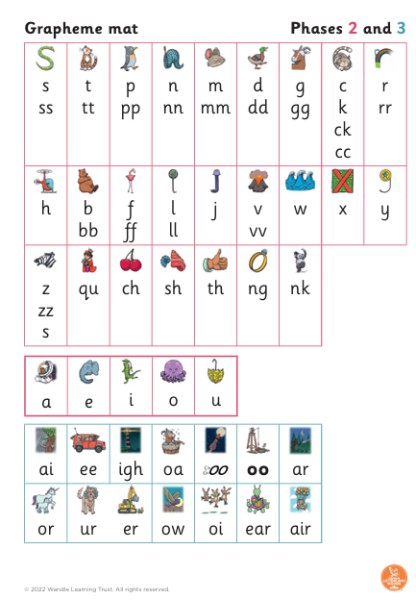
In Reception, children are introduced to simple letter-sound correspondences during the Autumn Term. As each set of letters is introduced, children are encouraged to use their new knowledge to sound out and blend words. For example, they will learn to blend the sounds s–a–t to make the word sat.
In Autumn term, Phonics lessons are 10-15 minutes long and extend to 20-30 minutes later in the year.
In Autumn Term, your child will come home with a wordless book. When your child is confidently blending words such as sat and tap, they will move on to reading books with words.
How can I read a wordless book?!
• Wordless books are invaluable as they teach reading behaviours and early reading skills to children who are not yet blending.
• Talk to your child about what they can see in the pictures.
• Point to the images in the circles and find them on the page.
• Encourage your child to make links from the book to their own experiences.
In Spring Term
• Your child will learn the Phase 3 vowel digraphs and trigraphs on their own and in words.
• They will continue to be taught the tricky words that they will read in their books.
• They will be reading either Phase 2 or Phase 3 decodable books, depending on where they are most secure.
What can I do to support my child at home?
• Ask them what sounds they have learned each day and point out objects in the environment or in books that start with that sound.
• Read to your child daily – choose books that you can enjoy together. The love of reading books we send home are a great place to start!
• Listen to them practise reading their phonics book to develop their fluency.
• Ask your child’s teacher if you need extra help with supporting your child.
• Support your child to complete their home learning.